Posted in Faith, Food and Forward Steps

January Monthly Check-In

Monthly Check-In: A Healthier Me

Month: January
 Year: 2026

How This Month Went (The Big Picture)

January felt rushed and hurried, yet somehow slow at the very same time. Getting sick right out of the gate didn’t help—especially since I turn into a full-blown carb hoarder when I’m under the weather. I crave pasta, brothy soups loaded with noodles and veggies, and endless slices of toast.

Then came the deep freeze. The kind of extreme cold that brings snow, keeps you indoors, and practically demands comfort food. Heavy meals. Cozy couches. Very little movement.

All of it added up to a start that didn’t exactly align with my health goals. Not because I didn’t care—but because winter, illness, and real life showed up first.


What Went Well

Celebrate the wins, big or small. Nothing is too minor to count.

·       Swapping sweets for cappuccinos.
Instead of our usual nightly ice cream, my sister and I started having cappuccinos in the evening. She got a Mambo coffee machine (not a coffee pot—an actual machine), and that small switch felt indulgent without being heavy. Same ritual, different choice.

·       Finding better recipes.
I came across several recipes that are high in protein and packed with vegetables. I may not have cooked them all yet, but finding them counts. It means I’m thinking ahead and setting myself up to make better choices soon.

·       Choosing to invest in movement.
I decided to get a treadmill—and I stopped caring about the cost. I’d rather invest in my health now than invest in medications later. That mindset shift alone feels like progress.


What Was Hard

This is a judgment-free space. Name the struggles without shame.

·       Not overeating.
Being sick, stuck inside, and surrounded by comfort food made it hard to stop when I was already full.

·       Not overloading on carbs during the snowstorm weekend.
Cold weather and snow days tend to push me straight toward heavy, carb-loaded meals—and resisting that pull wasn’t easy.

·       Not moving nearly enough.
Between illness, extreme cold, and too much couch time, my activity level dropped way more than I wanted it to.


Habits I’m Working On

The habits I’m intentionally building or strengthening.

·       More vegetables, less carbs.
Not elimination—just better balance and more intention with what’s on my plate.

·       More movement, less excuses.
Even small amounts count. Consistency matters more than perfection.

·       More encouragement, less influence in the wrong direction.
I want to cheer others on in healthier choices, not drag them into my own unhealthy habits.


Habits I Need to Let Go Of

The things that aren’t serving my health or peace.

·       Guilt.
It took 57 years to get this body to where it is—and that won’t be undone overnight. Guilt isn’t motivation; it’s baggage. I’m done carrying it.

·       Excuses.
Yes, some things are out of my control—like bitter cold weather that keeps me indoors. But that doesn’t mean movement isn’t possible. I can still show up for myself at home.

·       Procrastination.
It’s time to be a Day One girl and stop being a One Day girl. Waiting hasn’t worked. Starting will.


Food & Nourishment

How I fueled my body this month.

  • What worked well with eating? Swapping nightly ice cream for cappuccinos, paying more attention to protein and vegetables, and being more mindful of why I was eating—comfort versus hunger.

  • What needs adjustment? Portion awareness, especially with carbs during stress and cold weather. More consistent movement, even on indoor days. And planning meals ahead of time so healthier choices are easier to follow through on.

Accountability Corner

(Sharing with grace, not shame.)

  • Change this month: Gained a total of 0.6 lbs. Not ideal and not the direction I hoped for—but also not catastrophic. More information than failure, and something I can respond to moving forward.


Lessons Learned

What this month taught me:

This month reminded me that progress isn’t linear—and it rarely starts perfectly. Getting sick, being snowed in, and moving slower than planned didn’t mean I failed; it meant I was living real life.

I learned that small shifts matter. Swapping ice cream for cappuccinos. Looking for better recipes. Choosing to invest in tools that support my health. None of it was loud or dramatic, but all of it was intentional.

Most of all, this month taught me that grace and discipline can exist together. I don’t have to punish myself to change. I just have to keep choosing “day one” again and again.


Looking Ahead to Next Month

February – God’s Love & Grace

“Because of the Lord’s great love we are not consumed, for His compassions never fail.” — Lamentations 3:22–23

Health goals for the coming month:

Buy the treadmill and actually use it.
Not perfectly. Not every day. Just consistently enough to build the habit and make movement part of my routine.

Cook more, cook better, cook cleaner.
More meals at home using whole, simple ingredients—lean protein, vegetables, and foods that support how I want to feel.


Closing Thoughts

And just to say it out loud: getting sick, eating comfort food, and resting during a snowstorm is not moral failure—it’s being a person with a body. Health goals don’t disappear because January was messy. They just wait for you to come back with kindness.


Invitation

If you’re on a similar journey, I’d love to hear from you.
What worked for you this month? What are you struggling with?


© 2025 VikkiLynnSorensen. All Rights Reserved.
Posted in Moments and Musings

Don’t Waste Your Art on Anger

There’s a quote from the 1989 film Dead Poets Society that has stayed with me for years. Robin Williams’s character says:

“Poetry, beauty, romance, love—these are what we stay alive for.”

That line has always rung true to me. Art, in all its forms, was never meant to be a weapon or a megaphone for outrage. Art is about meaning. It’s about connection. It’s about beauty. It’s about reminding us—especially in difficult seasons—why life is still worth living.

And yet, the longer I spend in online creative spaces, the more I see art being used for something else entirely.

Around 2020, as I became more active on social media, I intentionally sought out communities built around the things I love. I adore books, so bookstagram felt like a natural fit. I wanted to talk about stories, discover new authors, share what I was reading, and write about the books that moved me.

That’s not what I found.

Instead, I found politics. Anger. Rage. Cancel culture. Public shaming. Nastiness—often aimed at strangers. And it wasn’t limited to one side of the political spectrum. It was everywhere. The joy of reading, the beauty of storytelling, and the love of language were drowned out by outrage and moral grandstanding.

I lasted maybe two years before I was tired. Not just annoyed—tired. Spiritually tired. Creatively tired. Emotionally tired.

A couple of years ago, I tried again. This time, I stepped into the online craft community. Once more, I hoped to find inspiration, encouragement, and artists whose work would challenge me to grow. I even saw it as a way to market what I hope will someday be a thriving business.

But here I am again, considering stepping away.

Why?

Because once again, I’m watching people use their art to express anger and rage.

Before this is misunderstood, let me be clear: this is not a commentary on anyone’s personal politics, nor is it a declaration of my own. I am constantly soul-searching, praying, and thinking deeply about what I believe. What I do know is this—man-made politics will always be imperfect. Always. Only God reigns supreme, and only His ways are perfect.

I also believe—strongly—that someone can love God wholeheartedly, serve Him faithfully, and maintain a beautiful relationship with Him while voting differently than I do. And that’s okay. Differences without division. My pastor says that often, and it’s something I hold onto tightly.

People love to say, “Art is political.”

I disagree.

Art is only political if you make it political.

At its core, art is meant to be beautiful and precious. It’s meant to tell stories, stir the soul, and create something that didn’t exist before. It’s meant to point us toward hope, not deepen our despair. As Dead Poets Society so perfectly puts it, poetry, beauty, romance, and love are what we stay alive for.

What troubles me most, though, is the contradiction I keep seeing.

The same artists who repeatedly say, “I craft for my mental health,” often create nothing but anger and rage. If every piece is fueled by outrage, if every project exists to provoke or condemn, how is that healing? How is that restorative? Anger doesn’t disappear once the project is finished—it lingers. What we pour into our art shapes us in return.

To be clear, this isn’t an announcement that I’m shutting down my Instagram account or walking away from social media entirely. It is a conscious decision to be far more intentional about what I consume, what I engage with, and what I allow to influence my heart. Protecting my peace isn’t avoidance—it’s stewardship. Not every conversation deserves my energy, and not every creative space is healthy for my spirit.

Above all else, my objective remains unchanged: to love the way Jesus loves—everyone, and at all times. That means choosing grace over outrage, humility over hostility, and compassion over the need to be right. I don’t want my creativity—or my character—to be shaped by anger. I want it shaped by love.

So if that means fewer hours scrolling and more hours actually creating, I’m okay with that. If that means stepping back from spaces that thrive on judgment and rage, I’m okay with that too. I’ll gladly trade noise for beauty, outrage for peace, and endless commentary for meaningful creation.

I’ll probably spend more time on Pinterest. I’ll definitely spend more time making things—things that are lovely, thoughtful, and life-giving. Things that remind me why I fell in love with art in the first place.

Because poetry, beauty, romance, and love really are what we stay alive for. And I refuse to waste my art on anger.

Scripture reminds us, “Finally, brothers and sisters, whatever is true, whatever is noble, whatever is right, whatever is pure, whatever is lovely, whatever is admirable—if anything is excellent or praiseworthy—think about such things” (Philippians 4:8). That is the posture I want my art—and my life—to reflect. Not anger. Not rage. But beauty, truth, and love.

A Prayer

Lord,
Thank You for the gift of creativity and for the ability to make things that reflect beauty, truth, and love. Guard my heart from anger that hardens and outrage that distracts. Help me to be a good steward of the gifts You’ve placed in my hands and the voice You’ve given me.

Teach me to create from a place of peace rather than reaction, from love rather than fear. When the noise grows loud and division feels tempting, draw me back to what is good, what is lovely, and what brings life. Shape my art so that it points to You and reflects Your grace.

Most of all, help me to love as You love—freely, generously, and without condition. May my words, my work, and my choices honor You in both what I create and what I choose to lay down.

Amen.

Posted in Moments and Musings

A Fed Baby Is a Loved Baby: It’s Time to End Feeding Shame

We need to say this out loud, clearly, and without qualifiers: stop shaming women for how they feed their babies.

Not every woman can breastfeed.
Not every body allows it.
Not every journey looks the same.
And no woman owes anyone an explanation.

I was physically unable to nurse my babies. Does that make me a bad mom? Absolutely not. And it doesn’t make any woman who bottle feeds a bad mom either. Yet for some reason, this topic is still wrapped in judgment—side-eyes, unsolicited advice, whispered opinions, and not-so-quiet shame.

We say we support women.
We say we uplift mothers.
We talk openly about postpartum anxiety, depression, and the need for community.

But too often, that support disappears the moment a woman doesn’t fit a specific narrative—especially the “breast is best” narrative.

Here’s the truth that doesn’t get said enough: many women grieve the breastfeeding experience they never got to have.
That grief is real.
That loss is real.
And it deserves compassion, not commentary.

For a woman already battling self-doubt and internal shame, constant judgment can be deeply damaging. Every comment, comparison, or well-intentioned “tip” can reinforce the quiet lie that she is failing before she’s even begun. Over time, that pressure can erode confidence, intensify anxiety, and contribute to depression—especially during an already vulnerable postpartum season. When a mother is questioning her worth, the last thing she needs is judgment disguised as advice. What she needs is reassurance, prayer, kindness, and tangible love. A gentle check-in. A thoughtful message. A phone call that says, “How are you really doing?” We are called to lift one another up—not pile on to a burden she is already carrying.

Why is it acceptable to speak openly about postpartum mental health struggles, yet remain silent—or worse, critical—when a woman cannot breastfeed? If we truly care about women’s mental health, we have to care about this too.

Scripture reminds us how we are called to treat one another:

“Therefore encourage one another and build each other up.”
—1 Thessalonians 5:11

Not tear each other down.
Not compare journeys.
Not assign worth based on feeding methods.

God does not measure motherhood by ounces pumped or minutes latched.

“The Lord looks at the heart.”
—1 Samuel 16:7

A mother’s heart is revealed in sleepless nights, in worry, in fierce love, in doing whatever it takes to care for her child. Feeding a baby—by breast or bottle—is an act of love. Period.

And let’s be very clear about the bottom line:

A fed baby is a healthy baby.
A fed baby is a loved baby.
A fed baby is what matters.

“Carry each other’s burdens.”
—Galatians 6:2

If women are truly going to support women, this is where it must begin. We don’t get to pick and choose which struggles are worthy of empathy. We don’t get to shame women while claiming sisterhood. Real support looks like grace. It sounds like encouragement. It shows up in prayer, in presence, and in saying, “You are a good mom.”

Because you are.

To every mother who bottle fed when she wanted to breastfeed.
To every mother who was physically unable.
To every mother who cried over a choice she didn’t actually get to make—

You are not broken.
You are not weak.
You are not failing.

You are a mother who showed up for her child. And that has always been enough.

Let’s stop the judgment.
Let’s stop the shaming.
And let’s finally start supporting women—all women—the way we say we do.

Closing Prayer

Lord,
We lift up every mother who is carrying quiet grief, heavy shame, or unanswered questions about her worth. You see the tears that fall in the middle of the night, the prayers whispered through exhaustion, and the love poured out in ways no one else notices. Wrap these mothers in Your peace. Replace lies with truth, guilt with grace, and isolation with community. Help them know—deep in their hearts—that they are seen, valued, and deeply loved by You. Teach us, Lord, to be gentle with one another, to speak life instead of judgment, and to reflect Your compassion in all we say and do. Amen.

A Call to Action

Let this be where change begins.

Before offering advice, choose empathy.
Before forming an opinion, choose prayer.
Before speaking, ask whether your words will heal or harm.

If you know a mother who struggled with feeding her baby, reach out. Send a message. Make a phone call. Sit with her. Remind her that she is a good mom. Let your support be visible—not just in sentiment, but in action.

And if you are a mother who has carried this shame yourself, know this: you are not alone, and you are not required to justify the way you loved your child.

Let’s stop the judgment.
Let’s stop the shaming.
And let’s start lifting women up—in prayer, in our words, and through loving deeds—exactly the way Christ calls us to.

Photo by Jaye Haych on Unsplash
Posted in Moments and Musings

From Goal-Getter to Grace-Seeker

I need to be honest here. Like pull-up-a-chair-and-confess honest.

I made goals. Big ones. Intentional ones. Prayerfully-written, color-coded-in-my-mind goals. If you’ve been with me at all this year, you already know this. If you haven’t, don’t worry—you can read all about them right here.

All five of them.

Yes. Five. With sub-goals accompanying each one. Because apparently I believe I am part human, part productivity app.

When I wrote these goals, I felt incredible. Inspired. Motivated. Practically unstoppable. I was that girl—the one who drinks her coffee while staring thoughtfully out the window, convinced she is about to become her “best self” by next Tuesday.

Fast forward one month.

Friends, I am unwell.

Instead of feeling accomplished, I feel anxious. Like someone blew a whistle and yelled, “GO!” and I didn’t realize I had signed up for a marathon—barefoot—while carrying a planner, a Bible, and unrealistic expectations. Suddenly it feels like time is running out and I’m already behind… even though no one set a deadline. Except me. I set the deadline. And then I forgot to give myself grace.

I keep reminding myself that new habits take time. Growth takes time. Change takes time. But apparently my patience has a very short shelf life. I want instant results. I want progress I can measure. I want gold stars. And when I don’t get them? I spiral.

To make matters worse, I lost an entire week to the flu. A whole week accomplishing absolutely nothing except surviving on crackers and cough drops. How dare my immune system interrupt my grand plans?!

So there I was, walking Percy, my emotional support dog who listens to my internal monologues whether he wants to or not. All of this was swirling in my head—the goals, the pressure, the frustration, the feeling that I was failing something I had just started.

And then the loudest thought rose to the surface, cutting through the chaos:

Keep God at the center of all this.

Because here’s the truth I know deep down: I can’t do anything without Him. Not one thing. Not one goal. Not one habit. Not one tiny step forward.

And that’s when the Lord gently—but very clearly—spoke to my heart:

“Then why are you trying so hard?”

Oof.
Here we go.
Another loving, well-timed, Holy-Spirit mic drop.

“Be a Mary, not a Martha.”

If you know, you know.

Martha—busy, frazzled, doing all the things, exhausted, resentful, stressed out, wondering why no one appreciates her hustle.
Mary—sitting at the feet of Jesus, fully present, fully at peace, choosing the one thing that actually matters.

And suddenly it hit me.

When I wrote my goals, I did do it prayerfully. I really did. But if I’m being honest? I haven’t prayed much about them since. I’ve been too busy chasing them. Too busy managing them. Too busy trying to force progress instead of trusting the process.

Somewhere along the way, my goals quietly took the place of my stillness.

Goals are not bad. Not at all. They can be good, healthy, and God-honoring. But they were never meant to outrank obedience. They were never meant to compete with communion. They were never meant to pull me away from sitting at the feet of Jesus.

And here’s the big realization:
The best goal I could ever have—the only one that truly matters—is to be with Him.

To sit.
To listen.
To rest.
To trust.

So I’m choosing this: my goals will no longer be more important than what God wants me to do. If He asks me to slow down, I slow down. If He rearranges my plans, I’ll let Him. If He says, “Come sit with Me,” then that’s the win for the day.

Because I have this quiet, holy feeling that if I place my goals back into His hands, He’ll arrange them in a way that actually makes sense. In a way that brings peace instead of pressure. Purpose instead of panic.

And maybe—just maybe—I can finally stop running around like a chicken with its head cut off… and start walking at the pace of grace.

Mary chose the better portion.And honestly?
I want that goal more than all of mine combined.

Photo by Randy Tarampi on Unsplash
Posted in Moments and Musings

The Power of Lifting Hands in the Darkest Moments

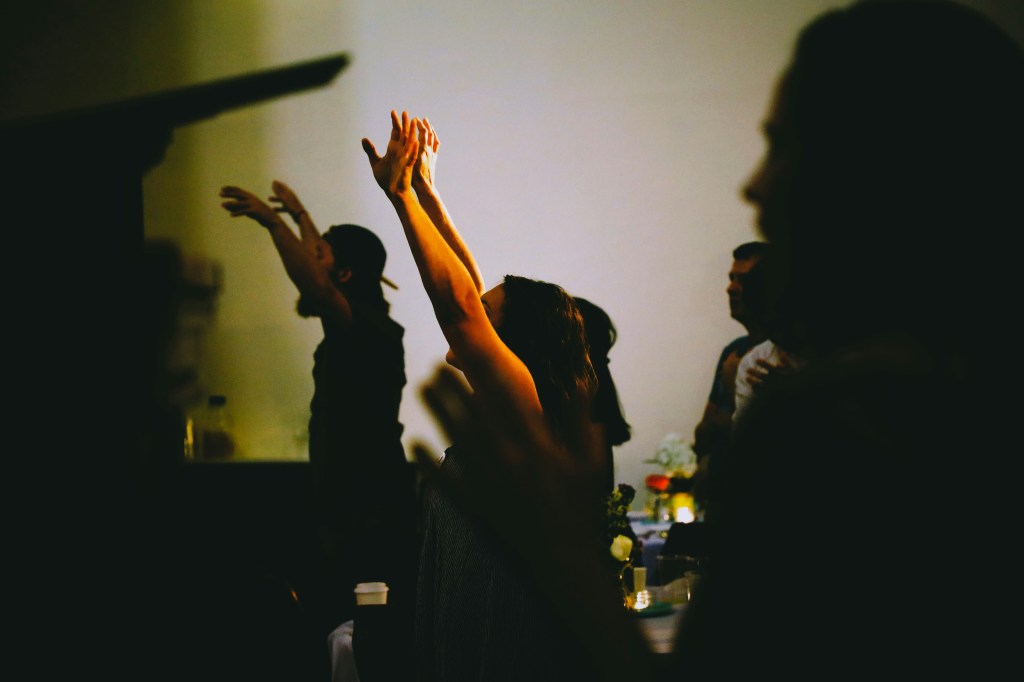
“So I will bless you as long as I live; in your name I will lift up my hands.”
Psalm 63:4 (ESV)

Years ago, I walked through one of the darkest seasons of my life. I was battling depression and anxiety with no professional support. My marriage was falling apart. I felt like I was trapped in a deep well—so deep that even God seemed unable to reach me. I had two toddlers running around, needing me every minute, and I felt like life was crumbling faster than I could hold it together.

I remember one night especially clearly. After yet another argument with my husband (now ex-husband), I tucked my babies into bed, walked to the couch, and broke down. I cried because I didn’t see a way out. I wanted to be strong for my girls. I wanted to be a better wife. But I had no idea how to climb out of the hole I was in. God felt so far away, and I felt like a failure.

Then, out of nowhere, a familiar Scripture came to my heart:

“Always be joyful. Never stop praying. Be thankful in all circumstances, for this is God’s will for you who belong to Christ Jesus.”
1 Thessalonians 5:16–18

Praise and worship had always been my favorite part of church. I’ve always loved to sing, and at the time, I was on the praise and worship team at my local church. I knew the power of praise. I knew what it meant to lift my hands. But in my depression, I couldn’t even find the strength for that.

I remember admitting to God, “I’m not sure I can even lift my hands anymore. I don’t even know why I should.”

And in that still, gentle way God speaks to our hearts, I heard Him ask,
“When your babies lift their hands to you, what does that mean?”

I answered, “It means they want me. They want me to pick them up and hold them.”

Then He said, “And what happens when you hold them?”

I replied, “They’re comforted. They feel loved. They feel safe in my arms.”

And God whispered,
“Then lift your hands to Me, daughter. Let Me lift you up and hold you. I will comfort you, love you, and make you secure in Me.”

From that day on, lifting my hands in worship became easy—not because life got easier, but because I understood. I remembered how it felt to lift my hands that night and be lifted by Jesus in return. In those moments, depression and anxiety melted away while I rested in the arms of my Heavenly Father.

Was life perfect afterward? No. The abuse in my marriage became adultery, which eventually led to divorce. My girls and I had to learn a whole new way of life. But none of that overshadowed what God had shown me:
Whenever the waves felt too strong, all I had to do was lift my hands—and He would lift me higher.

Today, my daughters are grown. They haven’t received this revelation yet, and they’re still shy in worship. But I’m not worried. I know their own conversation with God is coming. One day they will lift their hands, and when they do, God will hold them, comfort them, provide for them, and reveal Himself not just as their Heavenly Father—but as their Daddy.

Maybe you’re like I was—sitting in your own well of darkness or heaviness. Maybe you need to be lifted up, too. If so, can I pray for you?

A Prayer for the One Who Needs to Be Lifted

Heavenly Father, we love You so much. Thank You for Your Word that gives us everything we need in every season. Your Word tells us to praise You in all circumstances. And You know, Lord, that sometimes that’s hard. Sometimes we don’t have the strength. Sometimes our hands feel too heavy to lift.

But You are a Father who desires our freedom. You want us to know You not only as Abba but as Daddy. So today, by faith, we lift our hands to You. And as we lift our hands, we ask You to lift us up. Hold us close. Wrap us in Your arms. Let us feel comfort, security, and love. Thank You for pulling us out of the pit and placing our feet on solid ground.

We thank You and praise You for all this, in Jesus’ name.
Amen.

Photo by Jon Tyson on Unsplash